

He had been checking the gold rate every morning for three weeks.
First it went up. Then it dipped. Then it climbed again. Each time he was about to call Best Money Gold, something in him said: wait a little longer. Maybe tomorrow it would be higher.
Three weeks later, he was still waiting.
If you have ever done the same thing, this article is for you. Understanding what actually drives the gold rate, and how it behaves, will help you stop second-guessing and make a clear decision when the time comes.
Who Actually Sets the Gold Rate in India?
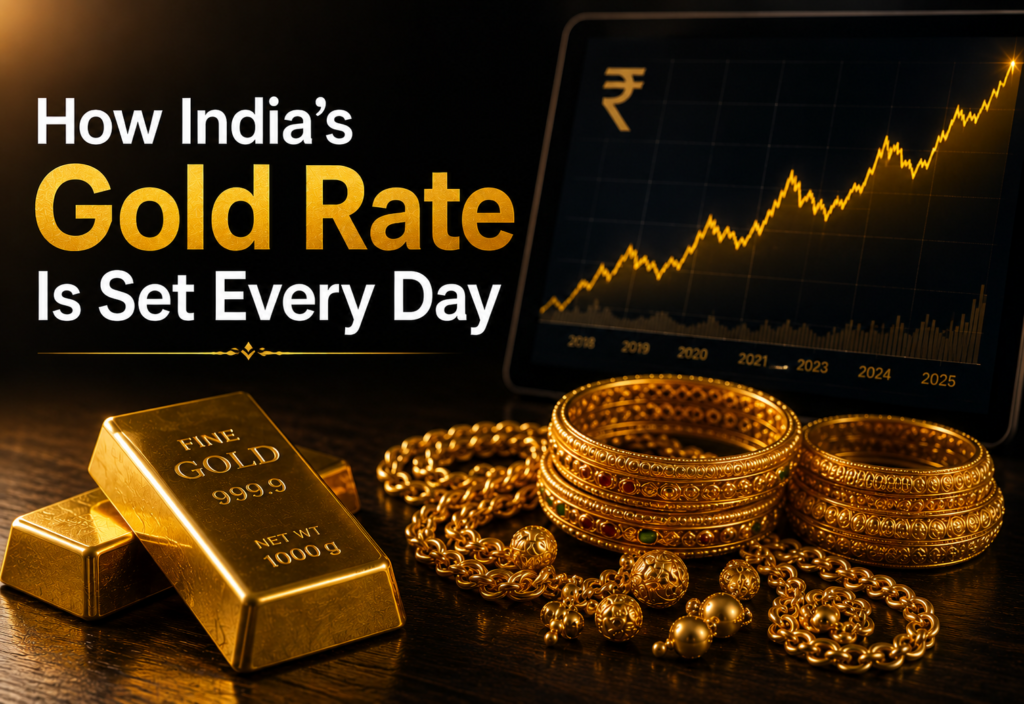
The gold rate you see on your phone every morning is not decided by any single person, company, or government office. It arrives from a chain of events that begins thousands of miles away.
Gold is traded internationally in US dollars on global commodity exchanges. Every second of every trading day, buyers and sellers across the world agree on prices. This continuous trading produces what is called the international spot price of gold.
In India, that price is translated into rupees through the Multi Commodity Exchange, or MCX. The MCX takes the international dollar price and converts it using that day’s rupee to dollar exchange rate. On top of that, India’s import duty on gold adds a fixed layer to the final domestic price.
What you see quoted as “today’s gold rate in Kerala” is the result of all three things working together: the international price, the currency exchange rate, and the import duty. None of these is controlled locally. None of them is set by any gold buyer in your city.
What Makes the Rate Move Up or Down?
The gold rate moves because the forces behind it are always shifting. Here is what actually causes those changes, explained without the economics textbook.
The strength of the US dollar. Gold and the dollar tend to move in opposite directions. When the dollar weakens against other currencies, gold becomes cheaper for international buyers, which increases demand and pushes prices up. When the dollar strengthens, gold often eases.
Global uncertainty. Gold has been a safe asset for thousands of years. When economies feel unstable, when there is conflict, when stock markets fall sharply, investors around the world move money into gold. This surge in demand pushes prices higher. You may have noticed that gold tends to be in the news during turbulent times for exactly this reason.
Central bank buying. When large central banks, including India’s Reserve Bank, purchase gold to hold in their reserves, it absorbs significant supply and supports prices. Central bank buying patterns have been a notable driver of gold prices in recent years.
Seasonal demand in India. India is one of the world’s largest gold consumers. When demand spikes domestically during wedding season or festival periods, it creates upward pressure on prices. This is one reason the gold rate in India sometimes moves independently of global trends during October, November, and the Akshaya Tritiya period in spring.
The rupee dollar exchange rate on a given day. Even if the international price stays flat, a weakening rupee means you pay more in Indian rupees for the same amount of gold. This is why the rate can change even when international markets appear quiet.
What 22K and 18K Mean for Your Daily Rate
The gold rate you see quoted in newspapers and on financial websites is almost always for 24K gold, which is pure gold with no other metals mixed in.
Most jewellery in India is not 24K. It is 22K or 18K. This is because pure gold is too soft for everyday wear and needs other metals mixed in to hold its shape.
The rate for 22K gold is calculated as a proportion of the 24K rate based on the purity percentage. 22K gold contains approximately 91.6 percent gold content. 18K contains 75 percent gold content.
This means that on any given day, your 22K jewellery is valued at roughly 91.6 percent of the quoted 24K rate per gram, and your 18K jewellery at 75 percent.
This is not a deduction made by the buyer. It is simply a reflection of how much actual gold is in your piece. The more gold it contains, the closer its rate per gram is to the 24K benchmark.
Is There a Best Time of Year to Sell?
This is the question most people are really asking. And the honest answer, the one that respects your time, is this: no one can reliably predict it.
Professional traders with access to real-time global data, currency forecasts, and geopolitical intelligence get this wrong regularly. The idea that a household gold seller can time the market better by waiting a few weeks is largely a myth.
What is observable is this. Gold tends to be stronger during periods of global instability. Prices are generally supported during the October to November festival season due to Indian demand. The Akshaya Tritiya period in spring also sees buying pressure.
But these are patterns, not guarantees. And there is a cost to waiting that people rarely account for. If you need cash for a medical bill, a school fee, or a business need, every week you wait is a week that need goes unmet. A rate that rises slightly over the next month may not even offset the cost of what you delayed.
One practical guideline that does hold: try not to sell on the same day as a dramatic spike or an unusual crash. Extreme single-day movements sometimes correct over the following few days. Outside of those moments, the difference between this week and next week, for the quantities of gold that most households own, is rarely material.
If the rate today covers what you need, and you have found a buyer you trust, that is as good a time as any.
A Myth Worth Clearing Up
Many sellers believe that different gold buyers offer different base rates for gold. This is not quite accurate, and understanding the distinction matters.
The base gold rate is the same for every buyer in India on any given day. It is derived from the MCX price and is publicly available. No buyer can change the base rate. What differs between buyers is the margin they apply on top of that rate to cover their operating costs.
At Best Money Gold, the base rate used in your valuation and the margin applied are both shown to you separately before you agree to anything. You can verify the base rate yourself on any financial portal or the MCX website before you walk in. If what you are shown matches what you see publicly, you know the calculation is honest.
This is the standard any buyer should be willing to meet. If a buyer cannot or will not show you the rate they are using and how they arrived at your offer, that is worth paying attention to.
How to Check the Rate Before You Visit
You do not need to rely on anyone to tell you today’s gold rate. It is publicly available every day.
Reliable places to check include the MCX website, the websites of major Indian financial newspapers, and the World Gold Council. The rate is updated throughout the trading day and typically settles by the time most buyers open their branches in the morning.
To get a rough sense of what your gold might be worth before visiting, take the net weight of your gold in grams, identify its purity, and multiply by the appropriate rate for that karat. This gives you a ballpark. Your actual offer will depend on the precise purity reading from testing and the net weight after non-gold elements are accounted for.
For a detailed explanation of exactly how the valuation works at Best Money Gold, the step-by-step guide on how your gold’s value is calculated walks through every stage of the process. The gold purity guide explains how 22K, 18K, and 916 hallmark relate to each other and to the daily rate.
Frequently Asked Questions
Does the gold rate change at night?
International gold markets trade continuously, so the price technically moves around the clock. The rate you see quoted domestically is typically based on the MCX closing or opening price for that trading day. For practical purposes, the rate you see in the morning is the rate that applies when you visit a branch during business hours.
Will waiting a month make a significant difference?
It might go up. It might go down. For most household gold quantities, the difference between this month and next month, even with a meaningful rate change, is not as large as people assume. A one percent change on 20 grams of gold is a relatively small amount. If your need is real and your decision is made, waiting for a better rate is a gamble, not a strategy.
Is the rate shown on television the same as what a buyer pays?
The rate shown in news broadcasts is the benchmark rate, which is what buyers use as their base. The actual offer from a buyer will be the benchmark rate minus a margin for their operating costs. The margin should be transparent and explained. At Best Money Gold, this calculation is always shown to the seller before any decision is made.
The Rate Today Is Real
The gold rate today is verifiable, transparent, and the same benchmark for every buyer in the country. What changes is how honestly a buyer applies it.
At Best Money Gold, one of the most trusted gold buyers in Kerala, the rate used in your valuation is the live market rate for that day. Every number is visible to you. No hidden margin, no unexplained deduction, no pressure to decide before you are ready.
When you are ready, we are here.
Kerala: 97503 97503