

You checked the gold rate before you left the house. Today’s rate, 24 karat, per gram. You had the number in your head. So when you walked into a gold buyer, sold your necklace, and the offer came back lower than that number, the first thought was obvious: something’s off here.
Nothing is off. What you ran into is one of the most common, and most rarely explained, gaps in how gold is priced in India. The rate you see published every morning is almost always the 24K rate. Almost everything you actually own, your necklace, your bangles, your earrings, is 22K, or sometimes 18K. Those are not the same number, and once you understand why, the gap between “today’s rate” and “my offer” stops feeling like a mystery and starts feeling like simple arithmetic. It’s also exactly the kind of question Best Money Gold’s team gets asked at the counter almost every day, which is why it’s worth explaining properly, once, in full.
22K vs. 24K: The Purity Difference in Plain Terms
Karat is just a measure of how much of what you’re holding is actually gold, versus other metals mixed in to make it strong enough to wear.
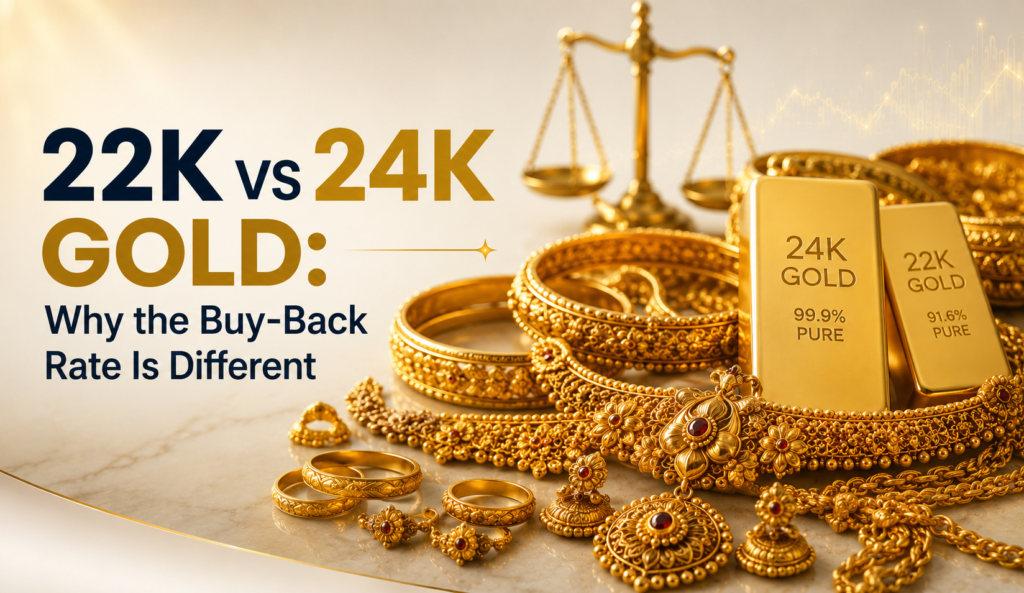
- 24K gold is 99.9% pure gold. It’s soft, soft enough that jewellery made from it dents and bends under normal wear. This is the karat used for coins, bars, and bullion, not everyday ornaments.
- 22K gold is 91.6% gold, with the remaining 8.4% made up of metals like copper, silver, or zinc. This alloy mix is what gives jewellery its strength and shape-holding ability. It’s why almost all Indian gold jewellery, the necklace you’re selling included, is 22K, not 24K.
- 18K gold, at 75% purity, shows up less often in traditional Indian jewellery but is common in diamond-studded or Western-style pieces, where durability matters more than maximum gold content.
So the math is straightforward: a gram of 22K gold physically contains less pure gold than a gram of 24K gold. If the published rate is for 24K, and your jewellery is 22K, the two numbers were never meant to match in the first place. This is standard across the gold trade, it isn’t a Best Money Gold-specific rule, but understanding it is the first step to reading any offer correctly, from any buyer.
Why Jewellery Shops Quote 24K Rates for 22K Items
Here’s where the confusion usually starts. Walk into almost any jewellery showroom and ask “what’s the gold rate today,” and you’ll be quoted the 24K number, even though the necklace on display is 22K.
This isn’t dishonest, but it is a convention that benefits from a little translation. The 24K rate is the reference rate, it’s the number published in the news, tracked by bullion associations, and used as the baseline for the entire market. Shops quote it because it’s the number customers recognize and expect to hear, and because it’s genuinely the anchor figure everything else is calculated from.
But the price you actually pay for a 22K piece, or the price you’re offered when selling one, isn’t the 24K figure. It’s the 24K figure, scaled down to reflect 22K’s lower purity, and then adjusted further for the specific piece. On the buying side, that adjustment usually goes up, jewellery shops add making charges, wastage charges, and sometimes GST on top of the metal value. On the selling side, it goes the other way: a gold buyer pays you for the metal content itself, without those additions.
At Best Money Gold, this is the whole point of quoting you the purity-adjusted rate up front, rather than starting the conversation with the 24K headline number and letting you work backward. You’re told what karat your piece tested at and what that karat is worth today, not left to guess why the final offer doesn’t match the number from the news.
How Your Buy-Back Offer Is Actually Calculated
A trustworthy gold buyer doesn’t guess your karat from the way a piece looks or feels. At Best Money Gold, purity is tested first, every time, and the test itself is free, before any number is discussed, and in front of you, not behind a counter. That’s true whether the item has a hallmark stamp or not, because stamps can wear off, be inaccurate, or simply need verification.
Once purity is confirmed, the calculation is genuinely simple:
Weight (in grams) × Purity percentage × Today's live rate per gram (for that purity) = Your offer
Notice what’s not in that formula: making charges, wastage percentages, or design premiums. Those were part of what you paid when you originally bought the jewellery, they cover the craftsmanship, the labor, the retail markup. None of that carries over when you sell, because a gold buyer isn’t reselling your necklace as a finished piece; they’re valuing the metal it’s made of. Best Money Gold applies this formula transparently, with no service charges added on top and no hidden deductions taken off, the number you see after testing is the number you’re paid, whether in cash on the spot or by bank transfer, typically within 30 minutes.
The purity testing step matters more than people expect. Two 22K necklaces of the same weight can occasionally test at slightly different actual purity, alloy ratios aren’t always perfectly consistent, and a proper test protects you from being under-valued just as much as it protects the buyer from overpaying. It’s also why Best Money Gold encourages customers to cross-check its valuation against other buyers: the process is built to hold up to scrutiny, not avoid it.
A Worked Example: Same Necklace, Two Different Numbers
Let’s make this concrete with illustrative numbers (not live rates, always check Best Money Gold’s current rate table on the day you sell).
Say the published 24K rate for the day is ₹10,000 per gram. Your necklace weighs 20 grams and tests at 22K purity (91.6%).
- If it were priced at the 24K rate: 20g × ₹10,000 = ₹2,00,000
- What it’s actually worth at 22K purity: 20g × ₹10,000 × 0.916 = ₹1,83,200
That gap, roughly ₹16,800 in this example, isn’t a discount, a fee, or a hidden deduction. It’s the mathematical difference between 22K and 24K purity, applied honestly. If you ever want to sanity-check an offer yourself, this is the exact formula to run the numbers with, and it’s the same formula Best Money Gold’s team will walk you through at the counter if you ask.
What This Means When You're Ready to Sell
Once you know the rate you saw on the news is the 24K reference number, and that your jewellery almost certainly isn’t 24K, the whole process gets a lot less confusing. The right questions to ask when you’re getting a quote aren’t “why isn’t this the rate I saw today,” but:
- What purity did the test confirm?
- What rate is being applied for that purity, today?
- Is the math, weight × purity × rate, actually adding up to the number I’m being offered?
This is exactly the standard Best Money Gold holds itself to, backed by over 90 years in the gold business as part of the Balamuthalagu Group of Companies, across 200+ branches spanning Tamil Nadu, Puducherry, Kerala and Andhra Pradesh. If you can watch the purity test, see the weight on the scale, and confirm the day’s rate for that karat, there’s no guesswork left, just arithmetic you can verify yourself, at any of Best Money Gold’s branches near you.
Frequently Asked Questions
Is 22K gold worth less than 24K gold, gram for gram?
Yes, purely on gold content, a gram of 22K gold contains about 8.4% less pure gold than a gram of 24K gold, so its metal value is proportionally lower.
Does purity testing ever raise the price instead of lowering it?
It can. If a piece tests at a higher purity than assumed, for example, closer to 23K than a typical 22K item, the calculated value goes up accordingly. Best Money Gold’s testing exists to find the true number, not to default downward.
Why does my old jewellery sell for less than I paid, even in 24K-equivalent terms?
That’s mostly about making charges, which you pay once at purchase and don’t get back at resale, a separate factor from the karat difference covered here.