

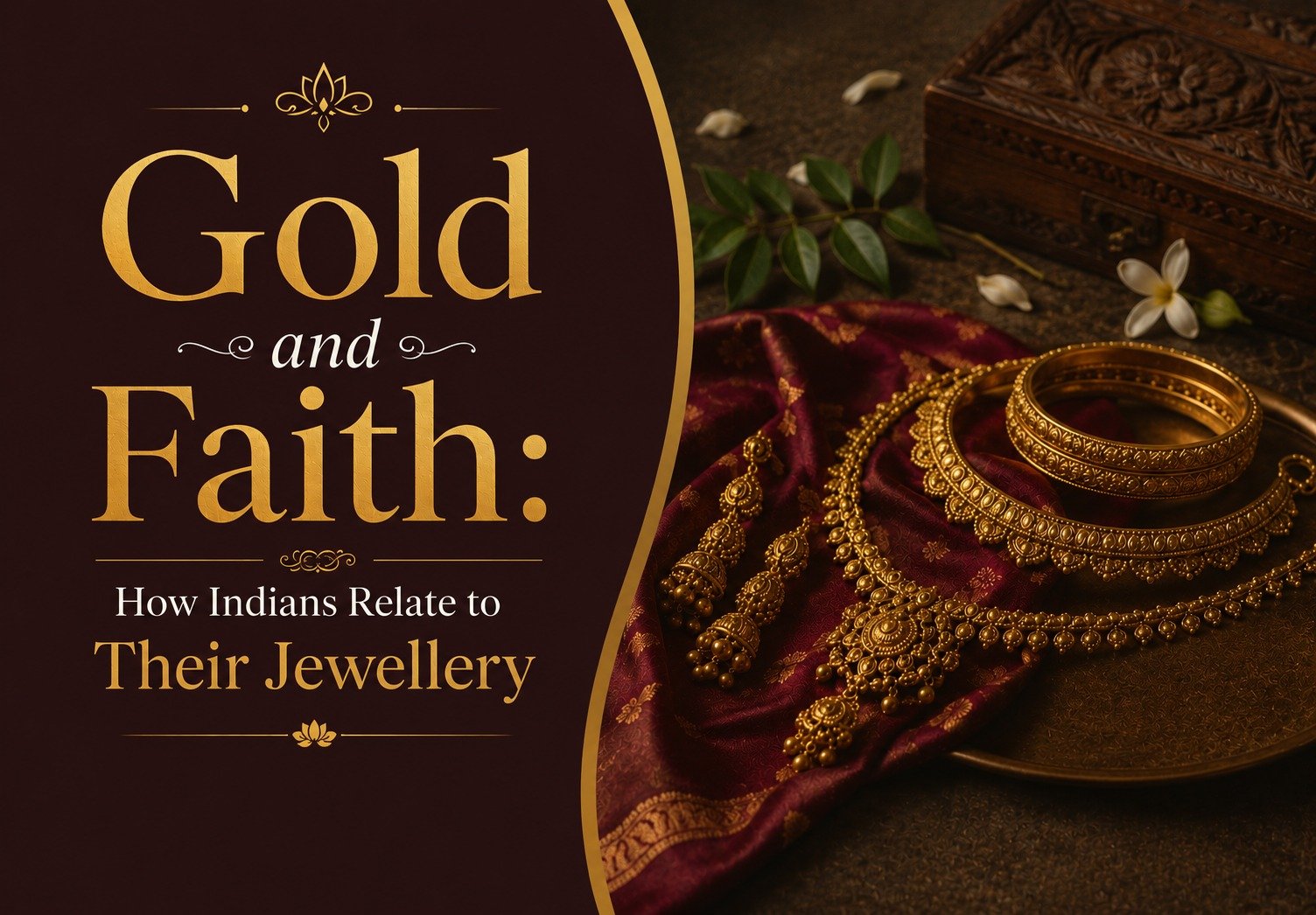
Gold and Faith: How Indians Relate to Their Jewellery
A grandmother leans over a sleeping newborn and slips a thin gold chain around the child’s neck. Her hands are careful, unhurried. She has done this before for her own children, perhaps for her children’s children. The gold she holds is not new. It has been passed through hands that have prayed, worked, celebrated, and grieved. And now it rests on this small new life, carrying all of that history forward. In India, gold has never been simply a precious metal. Long before anyone thought to discuss it as a financial asset, it was already part of how families expressed love, marked milestones, and held themselves together through time.
This is a story about that relationship.
Gold Is Not an Asset. It Is a Relationship.
Ask most Indian families why they buy gold, and the honest answer rarely begins with returns or market prices.
It begins with a memory.
A bangle gifted by a mother on the eve of a wedding. A chain received at a naming ceremony that a child still wears decades later. A ring that belonged to someone no longer here, kept not for its weight but for what it carries.
This is the foundation of gold jewellery significance in Indian culture faith, continuity, and the quiet language of love between generations. The emotional weight of a piece of jewellery often far exceeds its material value.
This is also why Indians buy gold even during uncertain economic times. Beyond financial security, gold offers something harder to measure: a sense of stability, of belonging, of being held by something larger than the present moment. It connects families to their past and offers something real to pass forward to the future.
Every piece tells a story. And over time, those stories become the family itself.
Gold in the Indian Calendar
Few cultures honour gold the way India does not just in homes, but in the calendar itself.
Throughout the year, festivals and family milestones create moments when gold becomes central to celebration. During Akshaya Tritiya, purchasing gold is considered an act of inviting lasting prosperity. Dhanteras holds similar importance across much of India, where families welcome good fortune through gold and silver.
In South India, these traditions feel especially alive. Vishu, Onam, and Pongal are occasions when the finest ornaments come out worn not to impress, but to participate in something meaningful. Gold traditions in South India are not merely customs. They are expressions of gratitude, identity, and devotion.
Life’s most important moments are also marked this way.
A child’s naming ceremony often includes a small gold gift from grandparents, the first jewellery a person will ever own. Engagement ceremonies involve the exchange of ornaments between families, a visible symbol of two lives beginning to join. And when it comes to gold in Indian weddings, the significance is unlike anything else.
For many brides, wedding jewellery represents far more than adornment. It carries the blessings of her family, the history of her home, and the emotional support of everyone who loves her as she steps into a new life.
The cultural significance of gold in India is inseparable from these moments. It is present at beginnings, at unions, at celebrations wherever something important is happening, gold is already there.
The Quiet Power of a Woman's Gold
There is another dimension to India’s relationship with gold that often goes unspoken: its role as a woman’s quiet foundation.
For centuries, a woman’s jewellery traditionally known as Streedhan represented wealth that belonged entirely to her. In times when women had limited access to financial systems or independent income, gold was something concrete and personal. It could not be easily taken. It did not require an account or a document. It simply was hers.
Mothers and grandmothers accumulated gold slowly and deliberately. A piece at Diwali. Something small on my daughter’s birthday. A bangle added after a good harvest or a successful year. Over decades, these accumulated quietly into something significant.
When difficulty came a medical emergency, an education fee that couldn’t wait, a family obligation that arrived without warning that gold was often what made it possible to respond.
This is why the importance of gold in Indian families cannot be reduced to tradition alone. Gold has served, practically and quietly, as a source of dignity and independence for women across generations. It was security stored in a form they could always trust and always access.
When the Time Comes to Let Go
Because gold carries so much meaning, the decision to part with it is never simple.
Families sell gold for many reasons: medical emergencies, a child’s higher education, clearing an important debt, helping with a family member’s wedding. These are real and pressing needs, and meeting them sometimes means making a difficult choice.
Some people feel they are losing a part of their history when they do this.
But there is another way to understand it.
Gold, in Indian tradition, has always been meant to serve the family. The jewellery that once blessed a grandmother’s wrists may, years later, fund a grandchild’s future. A necklace passed through three generations may be what allows a family to navigate a crisis with steadiness rather than panic.
When seen this way, selling gold is not a departure from tradition. It is often its deepest expression the same care and protection that the gold once symbolised, now taking a different form.
The memories are not in the metal. The memories are in the people. The blessings were never just in the ornament. They were always in the intention behind it.
How We Treat What You Bring to Us
At Best Money Gold, we understand that what you bring through our doors is rarely just jewellery.
Behind every chain, every bangle, every ring, there is a story. A wedding. A grandmother’s hands. A festival was celebrated long ago. A moment of quiet pride or deep love.
That is why we begin with respect.
With over 90 years of experience, more than 200 branches across South India, and the trust of over 500,000 customers, Best Money Gold is built on a simple belief: people deserve to be treated fairly, honestly, and with care especially in moments that matter.
When you choose to sell gold in South India, you should receive a process that acknowledges both the financial value of your jewellery and the significance of what you’re doing. Our evaluations are transparent, our pricing is honest, and our team understands that this is not a routine transaction for most people.
We are here to make it easier.
Conclusion
Think again of that grandmother and the newborn.
The gold she placed so carefully may travel far from that moment worn at a wedding, admired at a festival, inherited by another generation, or one day exchanged for something a family needs.
But the love in her hands as she placed it? That does not go anywhere.
That is the place gold holds in Indian life. It is memory and faith, security and story, all carried together in something small enough to fit in a palm.
When the time comes to understand the value of your jewellery whatever the reason Best Money Gold is here to help. With a free, transparent valuation and a process built on trust, we honour not just the gold you bring, but everything it has meant.