

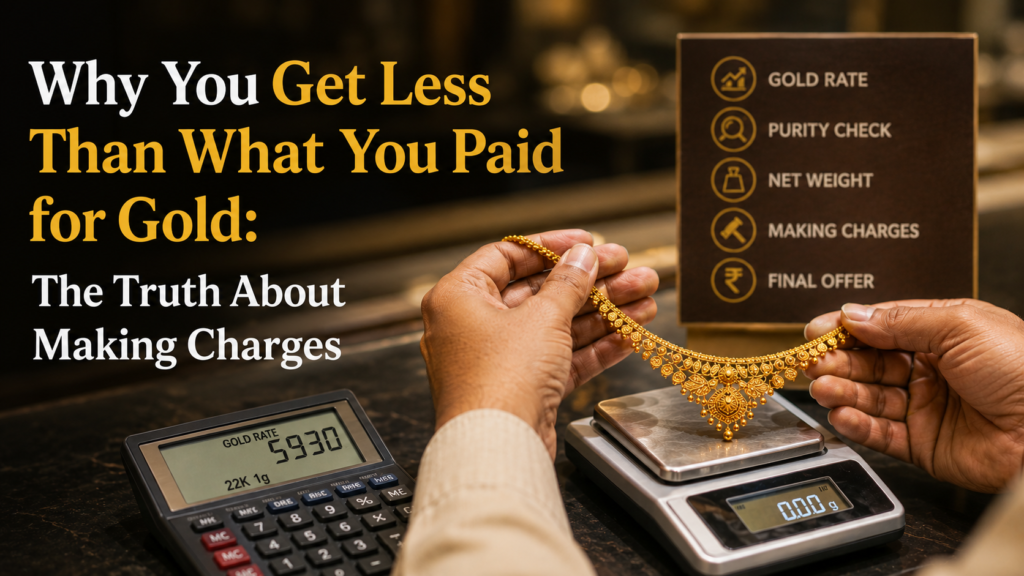
A gold necklace bought three years ago in Trivandrum. She remembered the price clearly because it had taken months of saving. When she walked into a gold buyer recently and heard the offer, her first thought was: something is wrong here. The number was noticeably lower than what she had paid.
She was not being cheated. The gap was real, it was honest, and it had a name.
It is called making charges. Once you understand what making charges are and why they exist, that gap stops feeling like a trap and starts making complete sense. This article explains exactly that, in plain language, before your next visit to a gold buyer.
What Making Charges Actually Are
When a jeweller crafts a piece of jewellery, they are not just melting gold and handing it to you. They are paying for skilled labour, for the design, for the tools, for the time, and for the small amount of gold lost during the crafting process itself. All of that cost gets added to the price of the jewellery as making charges.
On top of this, when you buy gold jewellery in India, GST is added at the point of purchase. One portion applies to the gold metal itself and another portion applies to the making charges.
So when you bought that necklace, you were not just paying for the gold inside it. You were paying for the gold, plus the skill that shaped it, plus the tax on both. All of that felt like one price at the time. But only one part of it has resale value.
Why Resale Buyers Do Not Pay for Making Charges
This is the part that matters most.
When you sell gold to a buyer, they are purchasing the raw metal inside the jewellery. That is it. The design, the finish, the craftsmanship and the artistry of the piece do not factor into the price because the jewellery will be melted down and refined back into base gold. The shape disappears. The pattern disappears. The effort that went into making it disappears.
Paying for making charges on resale would be like expecting a second-hand buyer to reimburse the delivery charges and showroom fees from when you first bought a product. Those costs belonged to that transaction. They do not carry forward.
This is not something specific to any one buyer or any one city. It is simply how the secondary gold market works. The best gold buyers in Kerala, and across India, all operate on the same principle: they pay for the gold content, not the jewellery as an object.
What you are selling is the gold. What you originally bought was the gold plus a service. The service does not come back with you.
What You Actually Receive When You Sell
When you bring your jewellery to Best Money Gold, here is what the valuation is based on.
First, the gold is tested for purity. This tells the team whether your piece is 22 carat, 18 carat, or another grade. Then it is weighed. Any non-gold parts, like stones, wax fillings, or other materials, are accounted for separately because they are not gold and are not included in the gold price.
What remains is the net gold weight. That weight is multiplied by the current market rate for that purity on that day. A small margin is applied to cover the costs of refining and processing. The result is your offer.
Here is a simple way to think about it. If you have a 22 carat gold chain and today’s market rate for 22 carat gold is a certain price per gram, multiply your net gold weight by that rate. What you receive from a transparent buyer should be close to that figure.
The gap you see between your original purchase price and today’s offer is almost entirely explained by making charges and GST paid at the time of purchase. It is not a deduction made by the buyer. It is a cost that was always built into what you paid.
When the Gap Feels Larger Than You Expected
Not all jewellery has the same gap. Some pieces will have a wider difference between purchase price and resale value than others, and it helps to know why.
Heavily crafted pieces tend to carry higher making charges because more skilled work went into them. Antique jewellery, temple jewellery, and intricately designed sets all fall into this category. The more elaborate the design, the larger the making charge at the time of purchase, and therefore the wider the gap at resale.
Lower carat gold, like 18 carat, contains less actual gold per gram than 22 carat. So the base metal value is lower, even if the piece felt expensive when you bought it.
Gold bought during festive seasons, when the base gold price is already elevated, also tends to have higher making charges applied on top of that elevated rate. This compounds the non-recoverable amount.
The simpler the piece, the smaller the gap tends to be. A plain bangle or a simple chain will always have less distance between what you paid and what you receive, compared to an elaborate necklace set.
Gold Coins and Bars Are Different
If you have gold coins or bars to sell, the situation is more straightforward.
Coins and bars, especially those issued by banks, carry minimal making charges or none at all. They are priced almost entirely on their metal content at the time of purchase. When you sell them, the gap is much smaller, sometimes just a small percentage.
This is worth knowing if you are thinking about buying gold purely as a financial asset rather than as something to wear. Coins and bars hold their resale value more closely than jewellery does. Jewellery carries the added cost of design and craft, which is wonderful when wearing it but irrelevant when selling it.
One Thing to Do Before You Visit
Before you bring your gold to any buyer, take one simple step. Look up the current gold rate for your purity. This is publicly available and changes daily based on the market.
Get a rough sense of how much your gold weighs (gross weight, minus any stones or non-gold parts). Multiply that by today’s rate and you have a reasonable ballpark for what the metal inside your jewellery is worth.
When you visit Best Money Gold, one of the best gold buyers in Kerala with branches across Trivandrum, Ernakulam, Kottayam and beyond, every step of this calculation is shown to you clearly before you make any decision. The weight, the purity reading, the rate applied and the final figure are all visible to you. Nothing happens behind closed doors.
If an offer feels significantly lower than your calculation with no explanation, ask. A transparent buyer will walk you through every number. If they cannot or will not, that tells you something important.
A Few Questions People Usually Ask
Does bringing the original purchase receipt help? It does not change the offer price, because the resale value is based on current gold rates and purity, not on what you originally paid. But it can be a useful personal reference to understand the gap.
Can making charges be negotiated back when selling? No. Making charges are a cost of manufacturing and retail. They are not applied by the resale buyer and cannot be recovered through negotiation. The buyer simply did not collect them in the first place.
Are making charges different for different buyers? Making charges are set by the jeweller at the time of purchase, not by the resale buyer. What may differ between buyers is the margin they apply on top of the metal value. A buyer like Best Money Gold charges no service fee, which means more of the metal value comes back to you directly.
Is there any way to recover from making charges? Not at resale. The only scenario where making charges are partially recovered is if you exchange old jewellery for new jewellery at the same jeweller, and even then it depends entirely on that store’s exchange policy.
Before You Walk In, Know This
The difference between your purchase price and your resale offer is not evidence of a bad buyer. It is a structural feature of how gold retail works, and it applies everywhere.
What you deserve is a buyer who shows you exactly how the number was reached, lets you verify the purity and weight yourself, and gives you the space to decide without pressure. That is the standard to hold any gold buyer to.
At Best Money Gold, that is how every transaction works. Same-day cash, no service charges, and every number explained before you decide.
Visit your nearest branch or call us directly. If coming in is not convenient, we can come to you.
Kerala: 97503 97503