

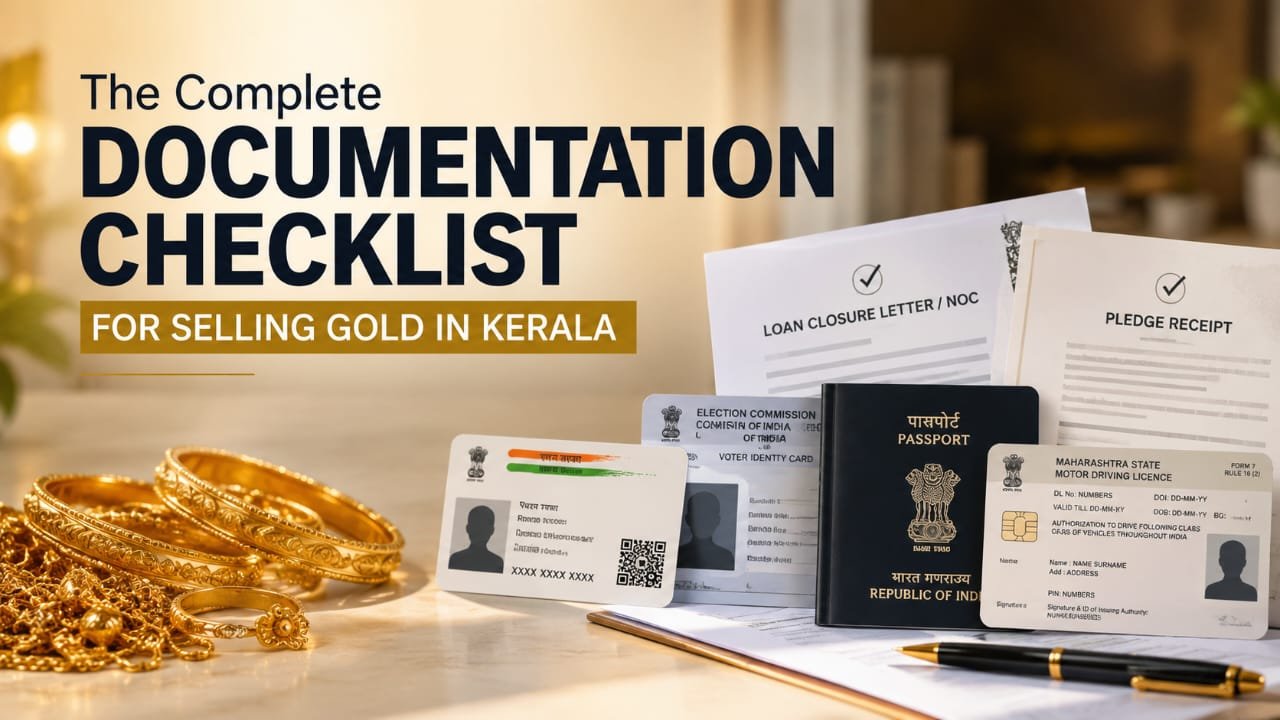
The Complete Documentation Checklist for Selling Gold in Kerala
Picture this: you walk into a gold buying branch with your jewellery, ready to sell, only to be told you’re missing a document. It’s a frustrating trip back home, and it happens more often than you’d think not because the process is complicated, but because most sellers simply don’t know what to carry.
The good news? Selling gold in Kerala is a genuinely simple process once you’re prepared. There’s no mountain of paperwork, no confusing legal jargon, and no need for a guarantor standing beside you. This guide walks you through exactly what you need, what’s optional, and what you can leave at home so your next visit takes minutes, not multiple trips.
Mandatory Documents for All Sellers
Every gold buyer in Kerala is required to verify seller identity before completing a purchase. This isn’t red tape for its own sake, it protects both the seller and the buyer, and it’s part of standard due diligence across the industry.
Government-issued photo ID Aadhaar card, Voter ID, Passport, or Driving Licence any one of these will do. If there’s only one thing you remember to carry, make it this. It establishes who you are and, indirectly, confirms your age too.
PAN card – required above ₹2 lakh Below ₹2 lakh, you generally won’t be asked for this. Cross that mark, though, and PAN becomes mandatory; it’s a standard financial compliance rule, not something specific to gold buyers. Selling a fair amount of jewellery in one go? Better to just carry it along and not think about it again.
Address proof Usually your photo ID already covers this Aadhaar and Voter ID both list an address. Only if yours doesn’t will you need something extra, like a recent utility bill, bank passbook, or rental agreement.
Age requirement There’s no separate age-proof document to hunt for. Sellers are expected to be 26 or older, and your ID takes care of proving that on its own just to make sure it’s valid and hasn’t expired.
Selling Inherited or Gifted Gold
A lot of sellers assume they need the original purchase bill to sell gold that was passed down to them. That’s not the case.
No purchase invoice required Nobody’s going to ask you to produce a decades-old bill for jewellery your grandmother left you. This is probably the most common worry sellers walk in with, so it’s worth saying plainly: not having the original invoice will not stop your sale.
Self-declaration, if requested For higher-value pieces, a branch may ask you to sign a short self-declaration confirming the gold is yours to sell. It’s routine paperwork, over in a couple of minutes nothing close to a legal hurdle.
Supporting documents, if available Got a gift deed or a will extract mentioning the jewellery? Bring it, it can speed things along. Don’t have one? That’s fine too, in most cases it’s simply not needed.
Selling Pledged or Mortgaged Gold
If the gold you’re selling was pledged with a bank or NBFC and has since been redeemed, a slightly different set of documents applies.
Original pledge receipt or loan slip This is the first thing you’ll be asked for, so it’s worth keeping it somewhere safe from the day you take the loan not stuffed in a drawer you’ll forget about.
Closure letter or NOC Once the loan is closed, get a closure letter or No Objection Certificate from your lender. It’s what confirms the gold is free of any claim and legally yours to sell again.
Matching ID Small detail, but it matters: the name on your ID should match what’s recorded against the pledge. A maiden name, a spelling difference, anything like that flag it with the branch beforehand rather than at the counter.
Original Purchase Bill or Invoice
Still have the original bill somewhere? Bring it along. It’s not mandatory, but it can make valuation and verification a touch faster, especially if the purity or hallmark needs cross-checking. And if you don’t have it — join the club. Most sellers with older or inherited pieces don’t, and it has never once stopped a sale from going through.
Quick Reference Checklist
| Document | Required / Optional | Notes |
|---|---|---|
| Photo ID (Aadhaar/Voter ID/Passport/DL) | Required | Establishes identity and age |
| PAN Card | Required above ₹2 lakh | Optional for smaller transactions |
| Address Proof | Required (if not on ID) | Utility bill, passbook, rental agreement |
| Self-declaration (inherited/gifted gold) | Situational | Requested at branch discretion |
| Gift deed / will extract | Optional | Speeds up verification |
| Original pledge receipt | Required (pledged gold) | Links you to the pledged item |
| Loan closure letter / NOC | Required (closed pledge) | Confirms gold is free to resell |
| Original purchase bill | Optional | Helpful, not mandatory |
What You Do NOT Need
Knowing what to skip saves you the trouble of overpacking your bag:
- Jewellery box or original packaging – it’s the gold that gets assessed, not the box it came in.
- Certificates from the jeweller – purity gets tested right there at the branch, so an external certificate adds nothing.
- A guarantor or second person- no need to drag someone along. You can walk in and complete the sale solo.
Frequently Asked Questions
Generally, yes as long as it's a valid, properly executed PoA, and both the owner's and the representative's ID are on hand. Give the branch a quick call beforehand though, just to confirm what they'll specifically want to see on the day.
Not a dealbreaker. Just carry a secondary address proof a recent utility bill or bank statement works alongside your ID to establish where you currently live.
Get in touch with your lender for a duplicate or a closure confirmation. Most banks and NBFCs will reissue it without much hassle, though it might take a few days to come through.
None at all. A single small item or a full set of jewellery the same documents apply either way.
Ready to Sell? We're Here to Help
Even if you’re unsure about a specific document or your situation doesn’t quite fit the checklist above, don’t let that stop you from visiting. Our team at Best Money Gold is happy to guide you through the process in person and clarify exactly what’s needed for your case a quick call ahead of your visit can save you a trip if anything’s unclear.