

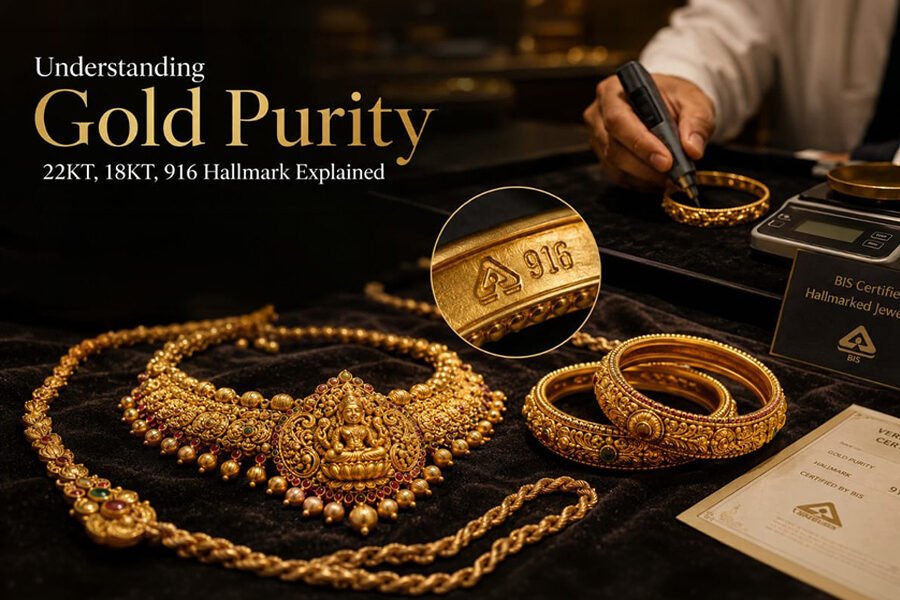
Understanding Gold Purity: 22KT, 18KT, 916 Hallmark Explained
You’re holding a chain your grandmother gave you, or maybe a set of bangles that’s been sitting in a locker for years, and the same question keeps coming up: what is this actually worth? It’s a fair question, and honestly, most people can’t answer it not because they don’t know gold, but because nobody ever sat them down and explained purity properly.
That’s really where everything starts. Before a number gets quoted, before any weighing happens, purity is what decides the value. So let’s go through it the way it should have been explained the first time — 22KT, 18KT, 916, all of it, in plain terms.
What Does Gold Purity Mean?
Here’s the simplest way to put it: purity tells you how much of a piece is actual gold, and how much is something else mixed in. Pure gold, 24 karat, is soft. Too soft, in fact press it a little too hard and it bends. That’s not exactly what you want in a ring you wear every day.
So jewellers add small amounts of other metals copper, silver, sometimes zinc to give the gold some backbone. These are called alloy metals, and their whole job is to make jewellery durable without taking away too much of what makes it gold in the first place.
It’s a bit like brewing tea, actually. Strong tea leaves on their own would be almost undrinkable, so you add water until it’s something you can actually enjoy, still tea, just workable. Alloying gold does the same thing. You lose a little purity, but you gain something you can actually wear.
Understanding Different Gold Purities
Gold purity gets measured in karats, written as KT, and each number corresponds to an exact percentage of pure gold. Once you know the scale, reading any piece of jewellery becomes a lot less mysterious.
24KT Gold
This is as pure as it gets 99.9%. But because it’s so soft, you won’t find much 24KT jewellery around. It’s mostly reserved for gold bars and coins, where durability isn’t really the point.
22KT Gold
At 91.6% purity, this is the gold most people in South India grew up around. It holds its shape well enough for detailed traditional designs, while still keeping a high gold content — which is exactly why it’s stayed the standard for wedding jewellery for generations.
18KT Gold
18KT comes in at 75% purity. The extra alloy makes it noticeably firmer, and that firmness is precisely why it’s the go-to choice for diamond and designer pieces. Stones need a setting that holds.
14KT Gold
Drop down to 58.5% purity and you’re at 14KT, more commonly seen in jewellery sold in the US and parts of Europe. There, everyday durability tends to matter more than gold content.
Purity | Karat | Gold Content | Common Use |
99.9% | 24KT | Highest | Bars, coins |
91.6% | 22KT | High | Traditional South Indian jewellery |
75% | 18KT | Medium | Diamond and designer jewellery |
58.5% | 14KT | Lower | International everyday jewellery |
What is a 916 Hallmark?
If you’ve ever noticed “916” stamped somewhere on a piece and wondered what it actually meant, here’s the answer, and it’s simpler than most people expect. 916 is not a separate type of gold. It’s just 22KT gold, written as a percentage instead of a karat number. 916 means 91.6 grams of pure gold in every 100 grams of the alloy. Same purity, different way of writing it.
This number comes from BIS, the Bureau of Indian Standards which runs the country’s official gold hallmarking system. A genuine hallmark isn’t just the “916” on its own; it usually comes with the BIS logo, the hallmarking centre’s mark, and a unique identification number tied to that specific piece. Put together, these marks confirm something important: that the purity claimed on the jewellery was actually verified, not just stated.
How Purity Affects Gold Value
This part is fairly mathematical, and once it clicks, it stays clicked. Higher purity means more actual gold in the piece and more gold means a higher payout for the same weight, at whatever the market rate happens to be that day.
Which is why two chains that weigh exactly the same can be valued quite differently. A 22KT chain will always fetch more than an 18KT chain of identical weight not because of the design or the craftsmanship, but purely because it contains more gold. Knowing your gold’s purity before you walk in means no one can shortchange you by quoting it as though it were a lower grade than it really is. And it’s also the reason transparent testing matters so much that purity should be checked openly, in front of you, before any number gets thrown around.
What If My Jewellery Has No Hallmark?
A lot of older jewellery simply predates hallmarking, or it was made by a local goldsmith who never got it certified in the first place. That doesn’t mean it’s worth any less it just means the purity has to be verified before anyone can put a number on it.
There are two common ways this gets done. Acid testing checks how the metal reacts when a small amount of acid is applied to a discreet spot different purities react differently. XRF analysis, short for X-ray fluorescence, is the more modern route: it reads the metal composition electronically without touching or damaging the piece at all. Either way, the point is the same jewellery without a hallmark can still be tested and valued fairly, it just takes one extra step.
Why Transparent Testing Matters
Once you’ve seen testing happen in front of you and actually watched the purity get checked and understood how that number turns into a price the whole process stops feeling like guesswork. It becomes something you can follow, not something you just have to take on faith.That openness is the difference between walking out wondering if you got a fair deal, and walking out knowing you did.
Frequently Asked Questions
916 gold is 22KT gold; the number simply refers to 91.6 grams of pure gold in every 100 grams of the alloy. It's the same purity, just written as a percentage instead of a karat number, and it's the standard used under BIS hallmarking.
There's no fully reliable way to test purity at home. A genuine hallmark stamp is the quickest indicator, but for jewellery without one, purity needs to be confirmed through acid testing or XRF analysis, both of which a gold buyer can carry out in front of you.
Neither is "better" ; they're simply different purities suited to different jewellery. What matters for selling is that 22KT contains more gold by weight than 18KT, so a 22KT piece will typically fetch a higher payout for the same weight.
Yes. Many older or inherited pieces predate hallmarking, but that doesn't affect their gold content. The purity just needs to be verified through testing before a fair valuation can be given.
Percentages make it easier to compare purity precisely 22KT and 916 look like different numbers, but showing both together (as most purity charts do) removes any confusion about what they actually mean.
Conclusion
None of this is complicated once someone actually explains it. 24KT is close to pure gold, 22KT is the everyday standard across South Indian households, 18KT holds up well for stone-set jewellery, and 916 is simply another way of writing 22KT under the BIS system. Purity is what drives value and going in already knowing yours changes the entire conversation.
If you’ve got jewellery you’re considering selling, hallmarked or not, Best Money Gold offers a free valuation where testing happens openly, right in front of you so you can see exactly how your gold is assessed before any price comes up.